
What is the best way to get rid of a verruca?
What is the best way to get rid of a verruca?
This is one question we get asked all the time. There is no simple one-size-fits-all answer, but we’ll try to explain how best to get rid of any verrucae.
Verrucae and warts are caused by a few different strains of the HPV virus. The virus gets into the skin as it is scuffed when coming into contact with surfaces where someone else with a verruca or wart has been in contact. You can pick up a verruca anywhere where you walk barefoot, but people who take part in certain activities which involve being barefoot often, like swimming, gymnastics, martial arts, yoga etc are more likely to pick them up. Verrucae can also transfer between family members on occasion.
As verrucae are viral, getting rid of them depends on the body’s own immune system. This means the body must develop antibodies to the specific type of HPV virus causing the verruca. The best way to encourage this immune response is through creating inflammation within the affected area. We always describe it as like sending a flare up to alert the white blood cells that the virus is there.
Without treatment, verrucae can last for several years. They don’t always need treatment (they can resolve in their own time), but for most people, the reasons for seeking treatment are either the fact that they can be painful, they look unsightly, or that they do not want them to spread to other people.
There are several ways to get rid of a verruca, and we will outline what we offer or recommend below. Our favourite way to get rid of verrucae is Swift Microwave Therapy, but we’ll go into detail about that later in this blog.
As far as treatments we offer or recommend, there are 4 main options.
Time, home treatments, topical treatments in clinic, Swift microwave treatments.
So, what are each of these options?
1.
The first one is time. Verrucae do go away on their own in time, without any treatment, but in some cases, this can take many years. For some people they resolve on their own fairly quickly, and if they are not painful or unsightly, it can be ok to let the infection run its course naturally.
2.
The second option is self-treatment. There are various home remedy treatments available. The most common is topical acid therapy, using salicylic acid, in products such as Bazooka or Wartner. If you are treating verrucae at home with these, we would recommend the strongest percentage of acid that is suitable. A Pharmacist will happily advise which the best product would be for age and type of verruca.
There are freezing treatments available over the counter, but we haven’t found these to be very successful, as in a lot of cases they don’t get cold enough to create the necessary inflammation.
There are also lots of other home remedy treatments suggested online, such as duct tape, or various essential oils, however there is little research evidence supporting the efficacy of these types of treatments.
3.
The third option is stronger acids, applied in clinic by a Podiatrist. The strongest acid treatment available over the counter is 26% strength. In our clinic, we apply 60% salicylic acid to verrucae. The way this treatment works is to break down the skin cells which contain the virus and encourage the necessary inflammation in the area. The treatment is applied approximately 1-2 weeks apart, depending on the skin’s reaction. The dressing containing the treatment must be kept in place and dry for several days. This treatment is a good option for those for whom our Swift microwave treatment is not suitable. However, it does have limitations, for example keeping dressings in place, for patients who swim often, or whose lifestyle would make it difficult to keep feet dry for several days. We find that the treatment can work well for the right patients, although it can take a little longer than our fourth treatment option, detailed below.
4.
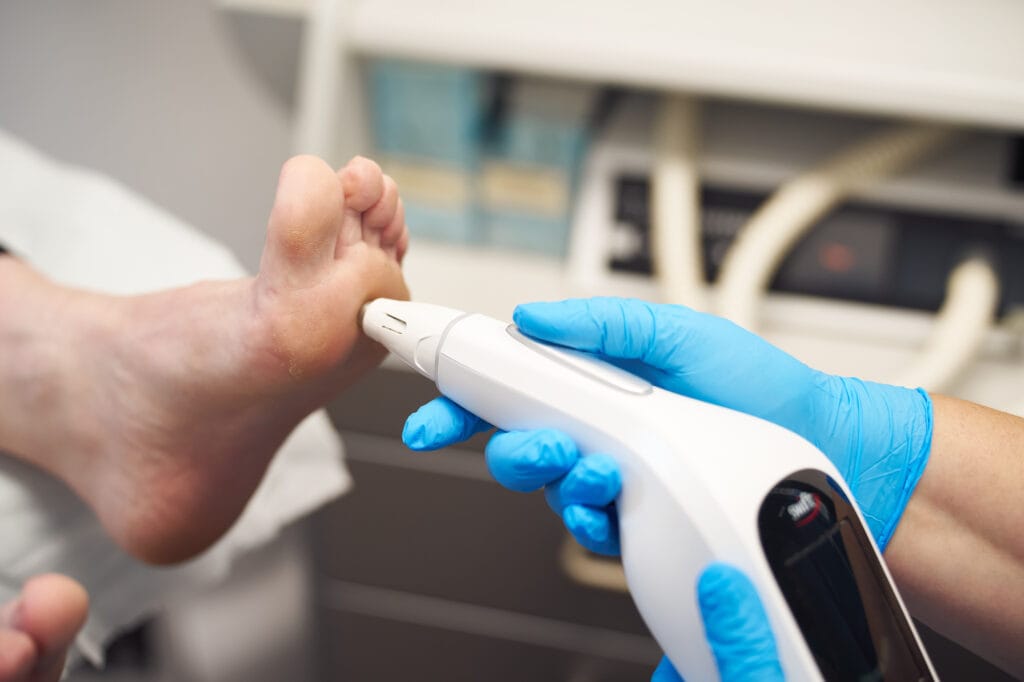
The fourth option is our Swift microwave therapy. This is our go-to treatment. Swift verruca treatment uses microwaves to apply heat to the affected skin, causing an inflammatory response. Microwaves create heat by making water molecules in the cells vibrate. The microwaves generated by the Swift treatment penetrate a few millimetres into the skin, to the layers where the verruca virus sits within the cells. The heat created during treatment is enough to start an inflammatory response, without destroying the cells. The benefit of Swift microwave verruca treatment is that there are no dressings required, and nothing needs to be done to the treated areas between appointments. Swift treatments are carried out at 4-week intervals. The treatment itself lasts seconds, but due to the heat created, the treatment can be slightly uncomfortable. However, this discomfort does not last after the treatment. It can take several applications for the treatment to be effective. We have been using Swift in our clinic now for almost 10 years, and find it to be a good, effective treatment.
This treatment is not suitable for those who have metal implants near to the verruca or wart, people with pacemakers or cochlear implants, those who have loss of sensation in the feet, patients who are pregnant or breastfeeding, or those with underlying medical conditions causing reduced circulation to the feet. The treatment isn’t always suitable for younger children, due to the discomfort experienced during the treatment.
Read more in depth information about our Swift treatment here.
Unfortunately, there is no single treatment for verrucae that works instantly. With any of the treatments described above, it can take time and persistence to get rid of a verruca. There is no set number of appointments or treatments that will eradicate a verruca. Each patient is individual and will have differing responses to their chosen treatment. There are time and cost implications involved with any treatment applied, and we will always explain each option available to allow you to make an informed choice as to which treatment would be the most appropriate for you.
During any treatment plan, we will regularly assess the progress of any lesions treated, and the type of treatment applied can be altered accordingly.
If you would like our help with a verruca or wart, or to discuss these treatment options, you can get in touch with us here.

Anna Conway
BSc (Hons), MCPod, SRCh, PGcert Podiatry
Owner, Lead Podiatrist